Let's talk about what learned helplessness is and how to prevent it. When students with complex needs are consistently supported by others doing things for them, they may eventually stop attempting tasks independently.
They have learned that someone else always steps in to help them with self care, daily living, or academic tasks.
This may be especially true for students who lack verbal speech or are unable to express themselves effectively.
Students may feel they have little or no control over their life. They may learn that their preferences, opinions, and efforts are unimportant and decide that it's pointless to engage or participate in the world around them. Students with learned helplessness may appear passive, hesitant, or disengaged, often waiting for prompts or assistance rather than initiating tasks.
When others repeatedly control their decisions and actions, students may start to believe their own efforts are ineffective or unnecessary.
I try to prevent learned helplessness in three ways: first, by making sure my classroom activities are planned with each student's skills in mind.
Second, by providing just the right amount of support to avoid over helping students.
And third, by offering choices to give the students some control over their environment.
Let's dive deeper into these three strategies.
In order to make sure my classroom activities are planned with each individual student's skills in mind, I collect some critical information. I make sure I really get to know my students, including their strengths, needs, preferences, reinforcers, and skill levels.
I accomplish this through gathering student and family input, reviewing the student's individualized education program, and collecting data on student performance.
By using this information to guide my planning, I can ensure activities are matched to each student's abilities and interests, which increases engagement and reduces frustration and learned helplessness.
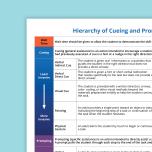
To provide just the right amount of support and avoid over helping students, I use the hierarchy of queuing and prompting. During each classroom activity, if a student can't complete a step independently, such as step four on this task analysis of using scissors, I choose the least invasive prompt from the hierarchy of cueing and prompting to help them with that step so I avoid over helping the student. If they need additional support, I move through the hierarchy with more invasive prompts one at a time, continuing if additional support is needed.
Making mistakes is an essential part of learning, and it is important for students to attempt what they can on their own. By giving students just the right support when they struggle, I allow them to learn from their mistakes and feel successful while still requiring them to do what they can independently.
This helps students build confidence and resilience, reinforcing that their effort and persistence lead to meaningful learning.
Providing available, appropriate choices gives students control within the limits I set. I can provide choices for academic tasks and materials such as which task to complete first in a subject, a worksheet or a task box, or which book to read to learn about main idea.
I can offer the student choices about their environment, like where they'd prefer to read a book, on the beanbag or the chair by the window, or if they want to read alone or with a peer. I can also offer them a choice of behavior rewards by letting them pick from activities or objects they enjoy.
For many of my students, I use a choice board with words, pictures, or objects as an added visual support when making their choices.
Even students who don't yet have verbal speech can participate in choice making by using other response modes, such as circling or pointing to indicate their selection from the choice board.
Planning instruction, providing appropriate supports, and offering choices all help prevent my students from developing learned helplessness and keeps everyone engaged in learning.