Special Education Informed Consent Legal Requirements and Best Practices
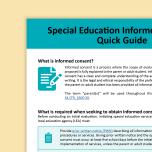
(bright music) - [Narrator] Welcome to the Special Education Informed Consent: Legal Requirements and Best Practices Training. This training will detail the legal requirements and best practices for local education agencies or LEAs to follow when obtaining informed consent for conducting full and individual initial evaluations or FIIEs, reevaluations when additional data is necessary, and initiating special education and related services. It covers the required elements of informed consent, the legal requirements for obtaining informed consent for special education evaluation and services, and the benefits of having a clear, dedicated informed consent process. Throughout the training, there will be many resources to reference and download. Let's look at three that are especially important to the content and structure of this training and can be easily accessed later. The Special Education Informed Consent Quick Guide highlights the key points and important resources for LEAs to consider for obtaining informed consent for special education evaluations and services. The quick guide provides an overview of procedures and requirements for obtaining informed consent and legal and state resources. Here are important legal and state resources to keep at your fingertips for information regarding requirements and best practices for obtaining informed consent. The Texas Legal Framework is an updated web-based platform to assist stakeholders such as LEAs, advocates, and parents in learning about state and federal laws and regulations by providing rich resources regarding obligations and rights for the provision of free and appropriate public education in the least restrictive environment to students with disabilities. The Parents' Guide is designed to give parents of children who are or may be eligible for special education and related services a better understanding of the special education process and their procedural rights and responsibilities so that they can fully participate in the decision-making process regarding their child's education. Legal references regarding informed consent and or ethical standards for educational diagnosticians, school psychologists, and speech language pathologists or SLPs are also provided so that you may read more about the requirements of these professionals. And finally, here are the websites for several professional organizations. We encourage you to consult your organization for additional recommendations for obtaining informed consent from parents or adult students. We encourage you to reference these sources to expand your knowledge further and improve your practice. Our learning objectives are that participants will build knowledge and gain an understanding of the following: required elements of informed consent, the legal requirements for obtaining informed consent for special education evaluation and services, the benefits of having a clear, dedicated, informed consent process, best practices and key points to remember when obtaining informed consent. As we explore the importance of informed consent, we will first focus on when informed consent is required. Throughout this presentation, when the term parent or parents is used, the term includes the definition aligned to Title 34 Code of Federal Regulations Section 300.30. That definition includes biological or adoptive parent, foster parent, guardian, an individual acting in the place of a biological parent with whom the child lives or is legally responsible for the child's welfare, or a surrogate parent as defined in Title 34 Code of Federal Regulations Section 300.519. Federal and state laws and regulations give specific requirements for obtaining informed consent for an FIIE, initiation of special education services, and reevaluations or FIE. Regarding obtaining informed consent for an initial evaluation, there are a few special situations we want to cover. If the child is a ward of the state or is placed in foster care and is not residing with the child's parent, the LEA is not required to obtain informed consent from the parent for an initial evaluation if, despite reasonable efforts to do so, the LEA cannot discover the whereabouts of the parent of the child. The rights of the parents of the child have been terminated in accordance with state law or the rights of the parents to make educational decisions have been substituted by a judge in accordance with state law, and consent for an initial evaluation has been given by an individual appointed by the judge to represent the child. Informed consent must still be obtained from the person or agency legally charged with making educational decisions for the student. If the parent of the child who is homeschooled or placed in a private school at parental expense does not provide consent for the initial evaluation or fails to respond to the LEAs request to provide consent, the LEA may not pursue the initial evaluation through mediation or due process hearing procedures, and the LEA is not required to consider the child as eligible for services. When obtaining informed consent for initiation of services, there are a few special situations we want to address. The LEA must make reasonable efforts to obtain informed consent to initiate services. If the parent refuses to respond or refuses to consent to the initiation of special education and related services, the LEA may not use the notice of procedural safeguards, including the mediation or the due process procedures to obtain agreement or a ruling that services may be provided to the child, will not violate its obligation to provide a free and appropriate public education when the parent does not respond or refuses to consent to the initiation of special education services. And when obtaining informed consent for special education services, the LEA should have proposed, reviewed, and developed an IEP for the student. It is not required to convene an ARD committee or develop an IEP for the student if the parent or adult student refuses to consent and the LEA will not violate the obligation to provide FAPE. Some special situations related to obtaining informed consent for a reevaluation are important to know. The LEA must make reasonable efforts to obtain informed consent for a reevaluation when new assessment data is necessary. Parental consent for a reevaluation does not need to be obtained if the LEA can demonstrate the parent failed to respond. Note that this does not apply when a parent refuses to provide consent. The LEA must make reasonable efforts to obtain informed consent for a reevaluation. If the parent of the child who is homeschooled or placed in a private school at parental expense does not provide consent for the reevaluation or fails to respond to the LEA's request for consent for reevaluation, the LEA may not pursue the reevaluation of the child by utilizing the notice of procedural safeguards, including the mediation or the due process procedures to obtain agreement or a ruling that the evaluation may be conducted and is not required to consider the child as eligible for services. Now we will focus on the federal definition of consent and the requirements of federal and state law and regulations related to informed consent. In the following slides, we will review a few critical keywords when informing parents and adult students in obtaining their consent. Let's begin our discussion of consent by reviewing the definition in federal law and regulations. Many of us use this term regularly, but when was the last time we read through this federal definition and focused on each component and our responsibility as evaluation professionals and service providers to ensure these are met when obtaining informed consent? The definition in federal law states consent, A, the parent has been fully informed of all information relevant to the activity for which consent is sought in his or her native language or other mode of communication. Now let's dive deeper into what these terms mean. For evaluations, being fully informed means that you make sure the parent or adult student clearly and completely understands why the evaluation is being recommended, including the multiple sources of data that led to the decision. Based on this data. when consent for evaluation is obtained, you should make them aware of the possible educational disability condition or conditions that could result in their child meeting the criteria for special education and related services. This should not come as a surprise to the parent or adult student at the time they receive evaluation results. You should also provide them a copy of the notice of procedural safeguards and the overview for Special Education for Parents Form and review the document with them. For initiation of services, being fully informed means that you make sure that the parent or adult student clearly and completely understands the recommended special education services and supports, including the multiple sources of data that led to the decision. You should also provide them with a copy of the notice of procedural safeguards and review the document if informed consent for the full and individual initial evaluation was obtained the previous school year. This will ensure your LEA meets the requirement to provide this document to the parent at least once per school year. For reevaluations, being fully informed means that you make sure the parent or adult student clearly and completely understands why the reevaluation is being recommended, including the multiple sources of data that led to the decision. Based on this data, when consent for evaluation is obtained, you should make them aware of the possible educational disability condition or conditions that could result in the child meeting the criteria for special education and related services. This should not come as a surprise to them at the time they receive evaluation results. You should also provide the parent or adult student a copy of the notice of procedural safeguards and review the document with them. Suppose information from an outside service provider, other individuals or agency is needed for the proposed activity. In that case, you must inform the parent or adult student and obtain their written consent. For example, suppose the child's physician needs to be contacted for input regarding ADHD and completing an Other Health Impairment or OHI Form. In that case, this must be fully explained to them and they must provide written consent. A separate consent form detailing the information or records that will be requested or released is required for each provider. This consent only pertains to the current evaluation or services. If consent is needed for a future activity, additional consent specifically for that purpose will need to be obtained. You should explain all required elements of informed consent to the parent or adult student in the language they best speak and understand. Using all information about the parents or adult students' language is important rather than relying solely on the home language survey. Suppose school staff has interacted with them indicating limited English proficiency. In that case, it is best practice to at least offer them the opportunity to have an interpreter present during the meeting. When using an interpreter, make sure they understand the requirements of the process, including the importance of confidentiality. When obtaining informed consent for an initial evaluation or reevaluation, the LEA must provide the parent or adult student the notice of procedural safeguards. The Special Education Information Center or SPEDTex offers the notice of procedural safeguards in several languages. You can access them at the link provided in the handout. You must ensure that the parent, adult student, or other person authorized to give informed consent is provided with all the relevant information in the mode of communication they use and understand. For example, it may be necessary to use an ASL interpreter for parents or adult students who are deaf or hard of hearing if appropriate. Consider the level of understanding and unique accessibility needs of the parent or adult student when explaining the consent process and adjust your words and presentation of information to meet individual needs. Now, let's look at the federal definition of consent. A, the parent understands and agrees in writing to the carrying out of the activity for which his or her consent is sought, and the consent describes that activity, enlists the records if any, that will be released and to whom, Title 34 Code of Federal Regulations Section 300.9 Consent. What is the benchmark for parent or adult student understanding? What does agrees in writing mean? What do you need to share about the evaluation or services being proposed? What do they need to know about the potential release of records? Let's explore these questions in more detail. It is important for you to use plain language and avoid technical and legal jargon when obtaining informed consent. It is also best practice to meet face-to-face with the parent or adult student to obtain consent. This helps you build rapport and establish a relationship with them, allows you to gather some preliminary information, gives them a chance to ask questions, and allows you to check for understanding. Whenever possible, consent for evaluation should be obtained by a professional with the training and expertise to fully explain the legal requirements, evaluation tools and procedures, and conditions being evaluated, as well as answer any questions the parent or adult student may have. This is typically the school psychologist, educational diagnostician, or SLP, depending on the scope of the evaluation, and which professional is serving as the evaluation manager. Suppose your district procedures assign this responsibility to other staff such as campus administrator or school counselor. In that case, evaluation personnel should contact them before beginning the evaluation to ensure they have been provided informed consent and thoroughly understand what is being recommended. A written signature is legally required for informed consent. Consent for evaluation or the initial provision of special education and related services cannot be obtained via a verbal agreement. Simply sending home consent paperwork for a parent or adult student signature or asking them to sign the consent form without fully explaining all activity components does not equal informed consent. In June 2020, the Office of Special Education Programs or OSEP stated that LEAs may use electronic signatures so long as the public agency ensures appropriate safeguards are in place to protect the integrity of the process. As we've emphasized, meeting with a parent or adult student face-to-face is a best practice to obtain informed consent. When this is not possible, there are important steps you, as school evaluation personnel, should take to ensure they are fully informed and are provided the opportunity for meaningful participation in the evaluation process. First, reach out to the parent or adult student via email or phone to notify them of the proposed evaluation and that you will be sending home the prior written notice for the proposed evaluation describing the purpose and areas of recommended assessment for their review. At this time, inform them that you will follow up to schedule a virtual or phone conference to explain the evaluation process in detail and allow them to ask questions. Once you have completed this conference and can verify that they fully understand the evaluation process, send the evaluation consent form home for their written signature. You can also obtain an electronic signature if your LEA operating procedures permit you to do so. When obtaining informed consent, you must thoroughly describe all aspects of the LEAs proposed activity. When seeking consent for an evaluation, explain to the parent or adult student the evaluation process and procedures for evaluating all areas of suspected disability. They should also be informed of all members of the school-based multidisciplinary team who will be taking part or may potentially take part in the evaluation. Relevant information to the evaluation includes that the multidisciplinary team will be using both informal measures such as review of records, teacher, parent, and or student input in interviews, and observations as well as formal measures, including norm referenced, standardized assessment instruments and rating scales in the student's native language or other mode of communication to address academic, developmental, and functional performance. The parent or student must complete and sign a separate consent to release or request information for each outside service provider. When obtaining informed consent for special education services, the LEA should have proposed, reviewed, and developed an IEP for the student. The LEA must ensure that they fully understand and agree with the decisions made about special factors related to the area of disability, the annual goals to meet the student's unique needs, and how progress will be gathered and reported. The special education and related services, including the frequency and duration of each service, supplementary aids and services to advance toward goal attainment, be involved in the general curriculum, and participate in extracurricular non-academic activities with children without disabilities, participation in state and district assessments, and determination of least restrictive environment after consideration of placement options. The third part of the federal regulations definition of informed consent addresses parent or adult student revocation of consent, Paragraph C of the Title 34 Code of Federal Regulations Section 300.9 states: one, the parent understands that the granting of consent is voluntary on the part of the parent and may be revoked at any time; two, if a parent revokes consent, that revocation is not retroactive, i.e., it does not negate an action that has occurred after the consent was given and before the consent was revoked; three, if the parent revokes consent in writing for their child's receipt of special education services after the child is initially provided special education and related services, the LEA is not required to amend the child's education records to remove any references to the child's receipt of special education and related services because of the revocation of consent. What does the term revocation mean? What does it entail regarding informed consent? We'll answer these questions and examine key concepts related to the revocation of consent next. An important part of the informed consent process is ensuring that the parent or adult student understands that providing consent for an evaluation or special education services is their choice and they can change their mind anytime. If they wish to revoke consent for an evaluation or services, they must do so in writing. Suppose they request revocation of special education services. In that case, the LEA should contact them to fully explain and ensure they understand the implications of this revocation for the student. It is essential to make sure the parent or adult student understands that if they do revoke consent, the revocation is not retroactive. This means that the revocation does not go back to the beginning of the activity and does not undo any action from when informed consent was given and when they revoked consent in writing. For example, if they submit a written request to revoke consent for an FIIE on day 25 of the 45 school-day timeline, the information obtained and assessment completed before day 25 is not erased. If a parent or adult student provides consent for initial special education services and then revokes that consent in writing after services have already begun, the LEA does not have to remove any documentation or references from the student's education record regarding the child previously receiving special education or related services. A case in point: if a student was identified as having the educational disability condition of specific learning disability in the area of reading comprehension and had been receiving special education services in the resource setting, this information would still be reflected in the student's educational record since it occurred before their revoked consent for services in writing. Now that we have examined the definition of informed consent according to federal regulations, let's tie it all together. Informed consent isn't simply a form or a signature. It is a process designed to ensure that the person who is authorized to give consent is fully informed about the details of the activity being proposed, that they completely understand what the consent is for, and that the consent is voluntary. Take a few moments and write down some benefits and important reasons for following the process presented in this training for obtaining informed consent. For example, number one, this process meets the legal requirements. Number two, along with meeting the legal requirements, this process guarantees the parent or adult student is fully informed of their rights and the process. It allows them to ask questions and gain any clarification about the proposed evaluation or services. Number three, when obtaining consent for initial evaluation, taking the time to meet with them in person and explain the evaluation process and obtain consent allows the opportunity to meet you and perhaps see the environment in which their child will be tested. This establishes the beginning of a positive relationship and creates rapport and trust. Number four, also meeting with them gives you a chance to do a preliminary parent or adult student interview and obtain significant information early in the evaluation process so that you can thoroughly plan the scope of the evaluation and obtain consent to contact physicians and other providers if needed. Also, meeting with them allows you to gather information to determine other concerns or suspected disability conditions early in the evaluation process. Number five, lastly, although this process takes time, this time and effort are well worth it. If the time is taken at the beginning of the process to ensure the parent or adult students are fully informed and have the opportunity to ask questions, there is less likely a chance of surprise or potential disagreement later. Before we end our video on informed consent, we want to share some helpful resources with you. There are resources and information related to informed consent on the Texas SPED support website, the legal framework for the child-centered special education process website, and Federal Regulations under IDEA B. We hope you find these resources helpful. Thank you so much for joining us today to learn more about informed consent. If you have any questions or need more information, please connect with your regional Child Find/Evaluation statewide contact. You can access the regional contacts on the Texas SPED support website.
This is a video regarding the legal requirements and best practice for local education agencies to follow when obtaining informed consent for conducting Full and Individual Initial Evaluations (FIIEs), reevaluations when additional data is necessary, and initiating special education and related services. It covers the required elements of informed consent, the legal requirements for obtaining informed consent for special education evaluation and services, and the benefits of having a clear, dedicated informed consent process.
Related Resource

ARD/IEP Supports, Child Find, Evaluation
Special Education Informed Consent Legal Requirements and Best Practices Handout
Child Find, Evaluation
